

emPOWERUP Virtual: What’s New in Proficy iFIX 2026
October 6, 2026emPOWERUP Virtual: What’s New in Proficy iFIX 2026
October 6, 2026EXPERT INSIGHTS
Alarm Management Challenges: Why Alarm Overload Happens
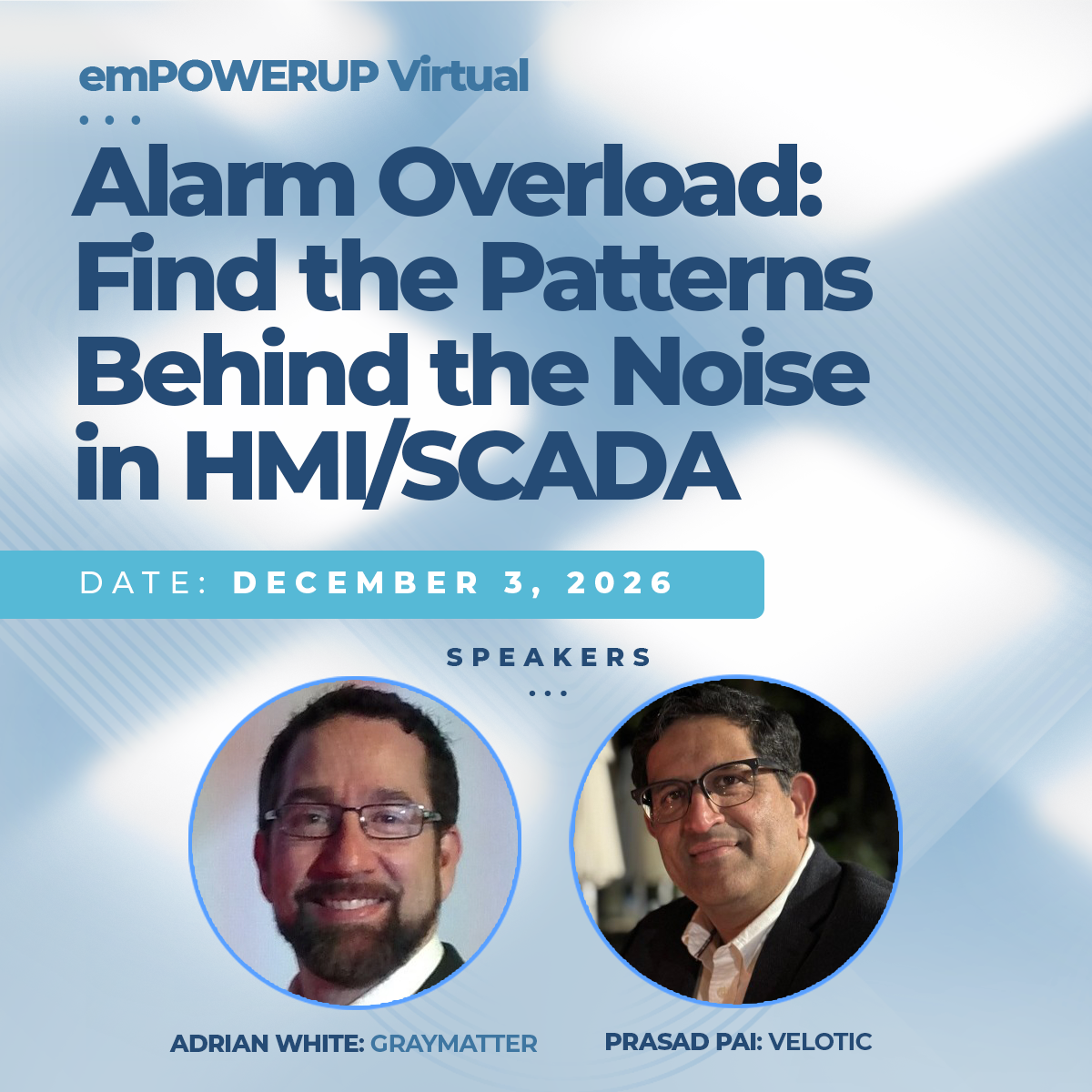
Why do alarm systems become noisy, and what can engineering teams do about it?
Join GrayMatter and Velotic for the webinar, Alarm Overload: Find the Patterns Behind the Noise.
By Adrian White & Prasad Pai
Industrial organizations have been working on alarm management for decades. Standards such as ISA-18.2 and IEC 62682 provide established guidance, and modern HMI SCADA systems offer capabilities to help teams prioritize alarms, reduce nuisance conditions, and get relevant information to the right operators. Yet alarm overload remains a common problem.
The reason is often less about knowing what good alarm management looks like and more about making it work in a real industrial environment. Plants change. Equipment is added. Processes evolve. Different engineers and system integrators work on the system. New requirements emerge.
Some alarm systems have challenges from the start. Others become increasingly difficult for operators to use as individual decisions and system changes accumulate over time.
Why do alarm management problems develop?
An alarm strategy may look straightforward on paper. Each alarm should have a purpose, an appropriate priority, a defined audience, and a clear operator response. Applying those principles across a working industrial system is more complicated.
Engineering teams make decisions within the realities of the process. A condition that requires immediate action in one application may only require monitoring in another. Normal process fluctuations can create unnecessary alarm activity if thresholds and timing are not configured appropriately. Operators responsible for one area may not need alarms generated elsewhere.
Alarm management decisions are highly dependent on the process, operating environment, and people using the system. Even reasonable individual decisions can contribute to alarm overload when they are made without a consistent strategy across the broader system.
Why aren't alarm management tools enough?
Modern HMI SCADA systems already provide many of the capabilities needed to improve alarm performance, including alarm delays, deadbands, shelving, suppression, alarm areas, filtering, and prioritization.
GrayMatter engineers frequently find that these capabilities are available but underused or inconsistently applied. As GrayMatter Solution Architect Adrian White puts it, “It’s less the tools that are available to customers and more the proper implementation of those tools.”
Using the tools effectively requires knowledge of the process and the people operating it. How long can a condition persist before someone needs to respond? Which operator is responsible? What priority accurately reflects the consequence and urgency? Is an alarm needed at all, or would another type of notification be more appropriate?
Software provides the capabilities. Effective implementation requires answering those questions in the context of the real operation.
How do alarm systems become noisy over time?
Even a well-designed alarm system can degrade as the environment around it changes. Think of it as alarm system drift. New alarms and configurations are layered onto existing ones, often by different people addressing different needs at different points in time. Without regular review, the alarm strategy can gradually move away from its original intent.
Operators are often the first to experience the result. Alarm summaries grow. Priorities become less meaningful. Repetitive or fleeting alarms compete with conditions that require action. Operators may develop workarounds or begin acknowledging alarms simply to manage the volume.
By the time alarm overload becomes obvious, the system may reflect years of accumulated changes. Recognizing alarm management as an ongoing engineering discipline can help prevent that drift from becoming the new normal.
How can engineering teams improve alarm performance over time?
Improvement does not have to begin with a plant-wide alarm rationalization project. Teams can start with an area where alarm activity is high or operators regularly encounter problems.
Talk with the people using the system. Review how alarms are configured and how they behave during actual operations. Identify conditions that generate noise, lack clear priorities, or reach operators who do not need them. Then continue measuring what happens after changes are made.
Historical alarm and event data can reveal which alarms occur most often, where floods develop, and whether changes actually improve performance. As systems generate more history, analytics and AI can also help teams identify patterns and relationships that would be difficult to find through manual analysis alone.
That creates an opportunity to make alarm management more informed by how the system is actually behaving, rather than relying only on how it was originally designed to behave.
How can better alarm management survive change?
An alarm system is never truly finished. The industrial environment around it will continue to evolve. The challenge is creating an alarm management approach that can evolve with it.
That means combining the capabilities already available in HMI SCADA systems with process knowledge, engineering judgment, operator input, and evidence from actual alarm behavior. It also means periodically asking whether the alarm strategy still reflects the system operators are running today.
When those practices become part of how the system is maintained, teams have a better chance of keeping alarm noise under control before it becomes alarm overload.
Join GrayMatter and Velotic for Alarm Overload: Find the Patterns Behind the Noise to hear perspectives from the field and see how alarm data, analytics, and AI can help engineering teams better understand alarm behavior and prioritize improvements.